





Sales Process Design

Build a Defined Selling Culture That Drives Results

What It Is

Sales Process Design is a customized selling model built specifically for your brand, your customers, and your frontline reality.

We design and implement a clear, repeatable sales experience that helps your team move from transactional conversations to consultative ones without sounding scripted or forced.

This isn’t off-the-shelf training. It’s a fully customized sales framework grounded in proven consumer selling principles and matched to real customer buying behaviors.

What It Solves

Most organizations don’t have a product problem. They have an execution problem.

Conversations feel inconsistent across locations or channels

Salespeople default to price and features

Upsell opportunities are missed

Leaders coach activity, not selling behaviors

The “way we sell” isn’t clearly defined

Sales Process Design creates structure and culture around the behaviors that drive performance. That means every customer interaction becomes intentional, differentiated, and aligned with your brand.

Whether your teams sell in call centers, retail, in-home, or field environments, the model is built for your specific sales motion.

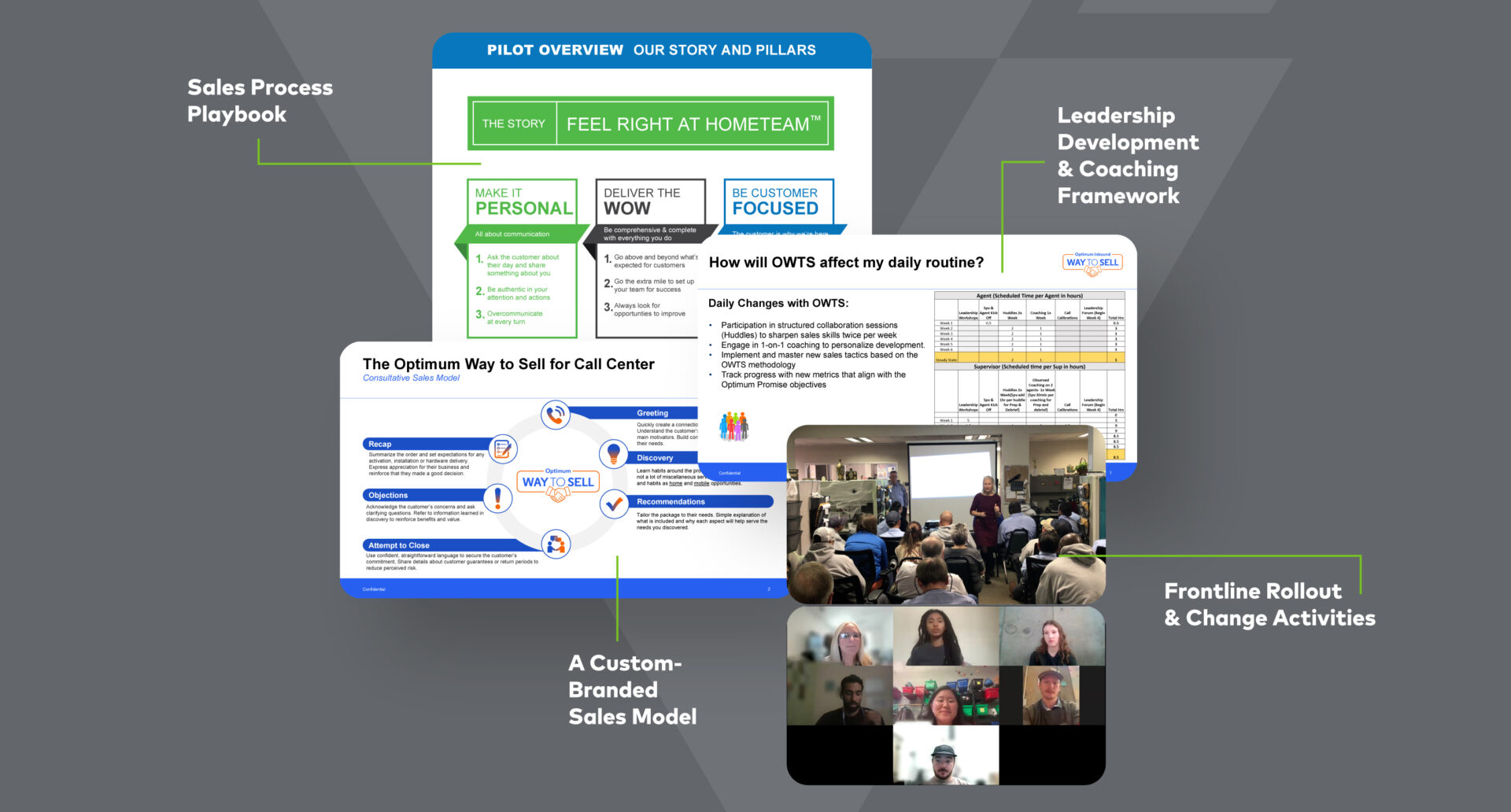
What Your Team Receives

1.

A Custom-Branded Sales Model

2.

Sales Process Playbook

3.

Leadership Development & Coaching Framework

4.

Frontline Rollout & Change Activities

Timeline & Process

A typical engagement runs a minimum of 12-16 weeks and unfolds in three phases:

Phase 1

Discovery

4 weeks

Phase 2

Development & Design

4-6 weeks

Phase 3

Activation

Minimum of 6 weeks

What results can I expect?

We work with each client to identify their improvement goals and analyze their ROI potential for our programs.

Every client is unique, with different product and service offerings and performance baselines. But, below are common performance indicators we impact and some historical results we use for estimates.

Conversion/Close Rates

Our programs have delivered never less than 7% and as high as 46% increases in sales conversion. Our guidance is to use 7%-15% as a safe estimate for expected sustained improvement.

Attach/Upsell Rates

Our clients have consistently seen increases of 15%-40% on attach rates for additional products and services. Some as high as 400%.

Other metrics include:

How much does the Program Cost?

How Pricing Works

The Sales Process program is a complete system, not a menu of services. Each component is necessary to deliver the desired results and lasting change.

Typical Program Investment: $90,000 – $150,000

This range typically delivers:

What factors could affect the cost?

Pricing depends on a few key variables:

1. Sales Team Size

2. Channel Complexity

Will this be worth my investment?

Calculate what 10% improvement in overall revenue would mean to your business. We have consistently shown across multiple metrics that we can help deliver that type of improvement.

For our typical client, that 10% improvement is worth a minimum of 10x the investment they make in our program.

We will work with you to build the business case, but hopefully, this guidance helps evaluate whether we are a fit for your team and budget.

Person using a calculator while reviewing documents and financial reports at a desk.

Related Case Studies

Two pest control technicians in blue uniforms standing by a service van with equipment.
Case Studies
Consultative Sales Process & Methodologies, Sales Enablement & Alignment Strategies
Creating a “Secret Sauce” for Customer Interactions

The client operates more than 50 local branch locations across the southern United States and is part of a larger portfolio of pest control companies. Their services range from a unique built-in, subscription-based pest control system to one-time treatment visits.

Leadership wanted to create a program that all customer-facing teams could follow, including new customer sales, branch-based customer service, and in-home technicians.

View Case Study
04/06/2026
Athletes climber moving up on steep rock, climbing on artificial wall indoors. Extreme sports and bouldering concept
Case Studies
Consultative Sales Process & Methodologies, Consumer Buying Habits
A Defined Guest Experience Model

The client operates more than a dozen specialty fitness locations across the US. Their unique model attracts a lot of outside guests and trial visitors who want to learn more about the facilities. Their objective was to deliver a consultative experience for guests who were exploring membership options.


View Case Study
04/06/2026
green tortoise jewelry laid out on surface same color surface
Case Studies
Consultative Sales Process & Methodologies, Consumer Buying Habits
A Customer-First Selling Strategy

The client operates a leading online jewelry brand. Customers shopping on their e-commerce site have the option to call and speak with a licensed jewelry consultant for assistance with their purchase.

View Case Study
04/06/2026
Group of customer service representatives sit at modern office workstation, focus on young Hispanic woman wearing headset engaged in conversation, assisting client or participating in virtual meeting
Case Studies
Consultative Sales Process & Methodologies, Sales Enablement & Alignment Strategies
Sales Culture Transformation

The client is a multi-state provider of internet, television, and mobile services. Their marketing strategy had shifted to focus more on home and mobile data products.

However, their sales model was still built around a legacy bundled offering. The team was no longer consistently following the process because it felt outdated, but they did not have a new approach to support the updated strategy.


View Case Study
04/06/2026

Frequently Asked Questions

Building a custom sales process isn’t one-size-fits-all. Here’s what clients ask before we start designing theirs.

Every Sales Process Design program is customized to align with the client’s brand, value proposition, and customer journey. This ensures the sales process reflects how the organization wants customers to experience the buying journey. Customization also improves adoption because the program is built around their company’s language and culture.


Sales process design is most valuable when a sales team lacks a clear structure, when the organization is undergoing a major strategic change, or when the current sales process is outdated. In these situations, defining a modern sales experience helps sales teams engage customers more effectively and create more consistent sales outcomes.

Our Sales Process Design programs can be delivered either virtually or in person, depending on the needs of the organization. Both formats are structured to encourage collaboration, discussion, and practical application for sales teams.

A small core team typically works with us during the development phase of the Sales Process Design program. One primary point of contact helps coordinate materials, stakeholders, and scheduling. In most cases, that individual spends approximately four to six hours per week during the program build process.

Learning sessions are delivered in small groups of 6 to 10 participants called cohorts. This format encourages discussion, peer learning, and practical application. Multiple cohorts can run at the same time, so there is no limit to the number of salespeople we can support.

Yes. Our program is designed for any customer-facing role that influences revenue or customer decisions. This includes sales teams, customer service representatives, retention teams, technicians, and in-home consultants. If a team regularly interacts with customers and has an opportunity to influence buying decisions or retention, the program can be adapted to support that role.


The Sales Process Design program itself does not function as a standalone onboarding course. However, we typically work with internal training or learning and development teams to integrate the behaviors, messaging, and sales process into existing onboarding programs so new hires can learn the approach early in their tenure.


A sales process and a customer experience model are closely related. Both focus on aligning the behaviors of customer-facing teams with the needs and expectations of the customer. In a sales environment, the goal is to guide customers toward a confident buying decision while creating a consistent and effective buying experience. Sales results and customer satisfaction should improve at the same time.

Our Sales Process Design programs are designed to work within the technology environment that clients already use. We help teams get more value from existing systems such as CRM platforms, conversation intelligence tools, coaching systems, and content management platforms. If technology gaps are identified, we can recommend trusted partners that support those needs.

Yes, we make sure every salesperson is recognized for participating in the program and provide them with credentials to show their skills and readiness to serve customers.

Sales process design starts by understanding the customer journey, the organization’s value proposition, and the conversations that typically occur between sales teams and customers. From there, clear sales stages, messaging, and conversation frameworks that are based on proven consumer engagement practices. Every process should feel natural and not scripted.

We don’t try to train all the behaviors at once. Our methodology introduces new actions one at a time. This gives the salespeople a chance to try a new approach and get comfortable with it before adding in more behaviors. The primary learning tool we use is called a “huddle,” where a facilitator guides teams through discussion, critical-thinking exercises, and practice activities.

Search InnerView

Click outside to close search